Your Ultimate Guide to Spring in Stardew Valley 1.6 (Spoilers Ahead)
Spring is a season of growth, opportunity, and fresh beginnings in Stardew Valley. This comprehensive guide covers everything you need to know to make the most of Spring, including crop strategies, festival tips, gift guides, fishing and mining advice, and farm planning strategies for both new and experienced players.
This guide should help cover all questions about Spring and make your start in Stardew Valley more refreshing and rewarding than stressful and confusing even if you’re a seasoned player.
Best Crops for Spring
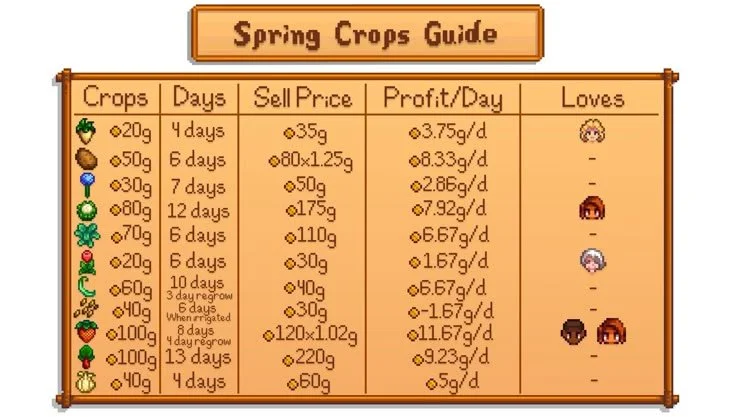
Spring offers a variety of crops with different growth and profit profiles. Below is a list of all Spring crops, including growth time, regrowth (if any), seed cost, and approximate profit per harvest (sell price minus seed cost):
Strawberries – 8 days to first harvest, then regrow every 4 days. Bought at the Egg Festival for 100g per seed. Very profitable and worth planting immediately after purchase.
Rhubarb – 13 days to grow, no regrowth. Purchased from the Oasis for 100g per seed. High profit per harvest.
Cauliflower – 12 days to grow, no regrowth. Seed costs 80g. Large yield and good profit for mid-Spring planting.
Green Beans – 10 days to grow, regrow every 3 days. Seed costs 60g. Multiple harvests make them a steady income source.
Potatoes – 6 days to grow, no regrowth. Seed costs 50g. Quick and moderately profitable.
Kale – 6 days to grow, no regrowth. Seed costs 70g. Fast-growing and reliable profit.
Parsnips – 4 days to grow, no regrowth. Seed costs 20g. Perfect early-game crop for quick income.
Garlic – 4 days to grow, no regrowth. Seed costs 40g. Moderately profitable and used in cooking recipes.
Blue Jazz – 7 days to grow, no regrowth. Seed costs 30g. Low profit but good for aesthetics or gifts.
Tulip – 6 days to grow, no regrowth. Seed costs 20g. Used for gifting or small profits.
Coffee Bean – 10 days to grow, regrows every 2 days. Purchased from the Traveling Cart for 2500g. Special case, very expensive early game.
Recommendations:
Early Spring: Plant fast-growing crops like Parsnips, Potatoes, and Kale to earn gold quickly.
Mid-Spring: Plant Cauliflower for high profit.
Egg Festival (Spring 13): Buy Strawberries and plant immediately to take advantage of their regrowth.
Green Beans are good for multiple harvests, but the first harvest may not be profitable.
Coffee Beans are optional; they are expensive but produce multiple harvests if planted and can provide use to make coffee that helps your player run faster.
Spring Festivals
Spring features two major festivals:
Egg Festival (Spring 13): Held in Pelican Town. Participate in the 60-second egg hunt for the Straw Hat prize. Eggs spawn in fixed locations around town. Memorize routes for speed. You can also buy Strawberry Seeds at the festival for 100g each. Plant them immediately to maximize harvests. The Egg Festival itself does not affect friendships. This festival is significant for Spring.
Flower Dance (Spring 24): Located south of Cindersap Forest. Tickets cost 20 gold or a Bouquet. Dancing with a villager grants +250 friendship (1 heart) if you have at least 4 hearts. Pick a partner for romance or friendship.
Tip: Schedule tool upgrades around festivals to avoid losing productivity. Rainy days are perfect for upgrades.
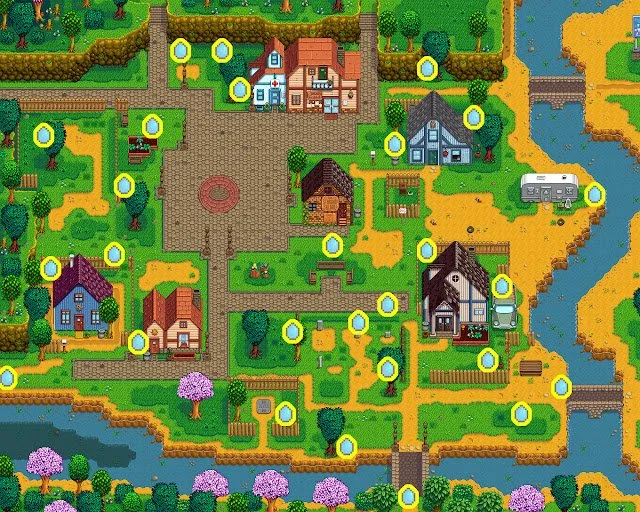
Egg Festival egg location gameplay screenshot routes
NPC Gift Guide (Spring Edition)
Spring foragables and simple crops can make excellent gifts. Some highlights (loved gifts) in spring include:
Wild Horseradish: Loved by Krobus. Found all over town/farms; sell for 50g and restore 13 energy.
Daffodil (Spring Seeds): Loved by Sandy, and others. Found everywhere; sells 30g (0 energy). (Excellent for gifting to villagers like Sandy.)
Dandelion: Loved by several (e.g. Sandy loves Dandelions). Common on farm/town, sells 40g, gives 25 energy.
Morel Mushrooms: Loved by George. Found in Secret Woods (and farm cave), sells 150g, 20 energy.
Spring Onion: Loved by Emily, Krobus, etc. (Not on CC bundles but good energy food: 13 energy, 5 health sells only 5g – use mainly for cooking).
Farm Crops: Garlic, Kale, or a single Spring Crop like Cauliflower can please villagers (many love veggies). Canned goods or wine from spring fruits also make stellar gifts later.
Birthday Gifts: Gift your friends on their birthday (extra +8 hearts if they like it). Spring birthdays include: Kent (4), Lewis (7), Vincent (10), Haley (14), Pam (18), Shane (20), Pierre (26), and Emily (27).
Giving a loved gift on that day is twice as effective! (For example, on Haley’s birthday, a deluxe bouquet or a diamond will skyrocket friendship, but spring veggies like Dandelions or Daffodils also give big boosts.)
Foraging in Spring
Spring’s wild goods are useful for bundles, cooking, and profit. Key forage items by location:
Common (all over): Wild Horseradish (50g, 13 energy), Daffodil (30g, 0 energy), Dandelion (40g, 25 energy). These spawn in fields, forests, and in the town.
Forest/Cindersap/Bus Stop: Leek (60g, 40 energy) appears in the Cindersap forest and areas (handy early energy).
Farm (southwest corner): Spring Onion (5g, 13 energy) – one patch, easy 13 energy boost each.
Salmonberries (15–18): Bushes around town and forest yield Salmonberries (5g, 25 energy). Not used in any bundles but good for quick energy, jelly, or saving for Gifts (some characters like Emily love Salmonberry).
Secret Woods: Morel Mushroom (150g, 20 energy) – rare, worth pick (especially liked by George). Secret Woods also has Wild Horseradish.
Treasure Spots: Occasionally dig up Clay, Artifact Spots, or branches (bees drop honey in Spring around logs).
Bundles: The Spring Foraging Bundle (in the Crafts Room) needs one each of Wild Horseradish, Daffodil, Leek, Dandelion. Completing it gives Spring Seeds, so gather at least one of each.
Spring Onions and Salmonberries are not required but are free resources to grab anyway (Spring Onions feed, Salmonberries can be turned into jelly - which is a good source of profit).
Usage: Eat Leeks and Spring Onions for good energy early (40 and 13, respectively. Dandelions and Daffodils restore no energy, so only pick them for bundles or gifts/profits (40g and 30g each).
Salmonberries are fantastic for jam (50g jelly) and small gifts. Overall, forage anything you see early on – it frees up inventory space in summer and provides cheap buffing or cash.
Fishing In Spring
Spring fish can be caught in rivers, lakes, and the ocean. Here’s a breakdown by location and conditions:
Smallmouth Bass – River, all day, any weather - 50g each.
Sunfish – River, 6 AM–7 PM, sunny or windy - 30g each.
Shad – River, 9 AM–2 AM, any weather - 60g each.
Catfish – River, rainy days only, 6 AM–12 AM - 200g each.
Lake Fish:
Largemouth Bass – Mountain Lake, all day, any weather – 100g each.
Ocean Fish:
Sardine – Ocean, 6 AM–7 PM, any weather – 40g each.
Herring – Ocean, 6 AM–7 PM, any weather – 30g each.
Eel – Ocean, 4 PM–2 AM, rainy days only – 85g each.
Flounder – Ocean floor, 6 AM–8 PM, any weather - 100g each.
Halibut – Ocean floor, 6 AM–9 AM or 4 PM–9 PM, any weather – 80g each.
All River Fish Bundle (4 of River fish: Bass, Sunfish, Catfish, Shad, and Ocean Fish Bundle (3 of Ocean fish: Sardine, Tuna/Red Snapper (not spring), etc.) involve some of these. In spring you can catch the Sardine, Herring, Eel for Ocean and Bass, Sunfish, Catfish, Shad for River.
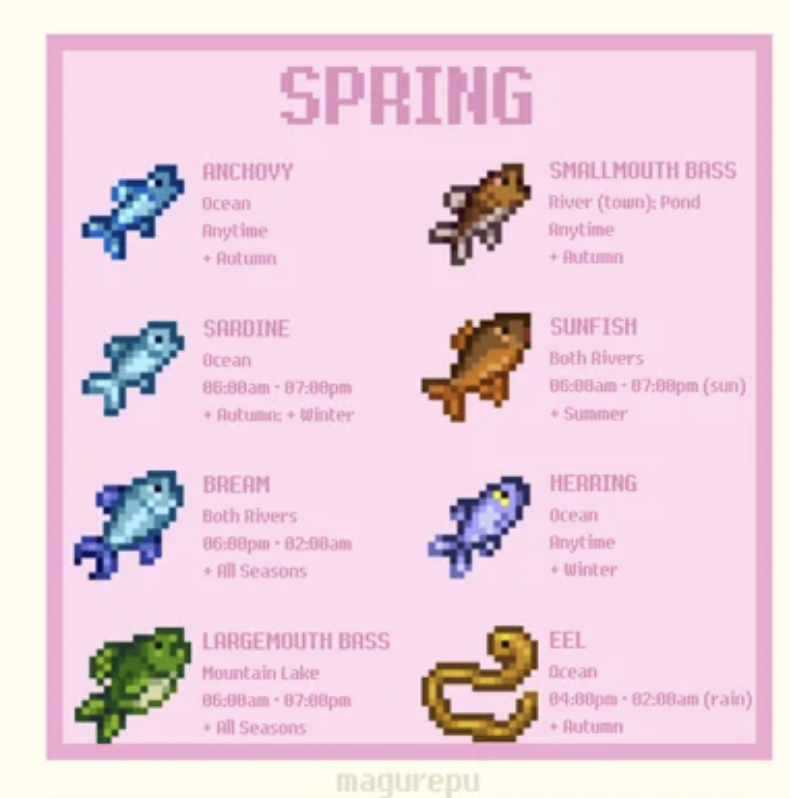
Source: @maqurepu on reddit
Profit/Difficulty: Catfish and Eel are valuable (200g/85g) but harder catches. Sunfish, Bass, Shad, Sardine, Herring are common and easy with 1-2 fishing bars of skill. Use bait and tackle to speed up catches.
Sell common fish for modest gold early; focus on bundle requirements. Flounder and Halibut are high-priced “sinkers” (they sink slowly, easier to get off the bottom), but only catchable in ocean during Spring/Summer.
Fishing Tips: Rainy days greatly increase fish spawns. Spring (unlike winter) has several rainy days to fish. Early on, catching the catfish (in town river on rain) is lucrative (200g) and needed for the River bundle. Save an Eel if targeting the Night Fishing Bundle. Also use crab pots with bait: they can yield Lobsters, Crawlers, and other goodies anytime.
Mining and Combat
The Mines unlock on Spring 5. Here are some tips:
Enter on Rainy Days: Mining and combat are great rainy-day activities (no watering needed for crops). Each entrance yields a Rusty Sword from Marlon, so you’re armed at floor 1.
Elevators (Checkpoints): Every 5 floors (5, 10, 15…) you get an elevator checkpoint. These floors are safe havens to exit and return. Plan to reach at least level 5 or 10 by May to get Copper and Iron.
Weapon Upgrades: Watch for better weapons in chests on milestone floors. For example, Floor 10 often has an Iron Dirk or Wooden Blade, and Floor 20 can give a Steel Smallsword or Wood Club. These beat the Rusty Sword, so grab them to speed up monster kills. Early kills (slimes, bugs) drop stone/ore and ladders.
Use Pickaxe Wisely: Upgrade your Pickaxe as soon as you have enough copper bars (requires 75 copper bars for Copper Pickaxe). Stronger Pickaxe breaks rocks and geodes faster, saving energy. If you prefer, buy copper ore from Clint and upgrade early (min-maxing).
Combat Strategy: Carry food for health. Use swords to quickly defeat slimes and bats. If overwhelmed, crouch near the ladder zone and stair-step to escape. The Forest Sword (floor 20) and Club (soil) are good early finds.
Rewards: Key floors: 40 (meet the Dwarf and choose to learn Dwarvish or get a Bomb recipe) and 80 (permanent elevator to floor 80). These are often achievable by Summer of Year 1 if you mine consistently.
Overall, ew players should explore steadily, returning once tired. Experienced players can speed-run using bombs or staircase crafts (crafted from 99 stone each) to skip floors and reach deeper levels. Farming minerals (Copper on floors 2–39, Iron 40–79) helps tool upgrades later.
Tool Upgrades
In spring, prioritize tool upgrades around your schedule:
Common Upgrade Order: Many players upgrade Copper Axe first (to clear stumps/wood faster for crafting and hardwood), then Copper Pickaxe (to reach deeper in mines), then Copper Hoe, and finally Copper Watering Can. However, order can vary by playstyle. If you rely heavily on farming early (Community Center goals or big crops), upgrading the watering can earlier is an option.
Rainy Days/Free Days: The best time to upgrade a tool is when you won’t be using it the next day. For example, upgrade the watering can on a sunny day if rain is forecasted for tomorrow. That way you water crops today, turn in the can, next day it rains (no watering needed), and pick up the upgraded can the following day. Clint can even finish upgrades on holidays (unlike Robin).
Festival/Deadline Awareness: Avoid dropping tools the day before festivals or big shipping deadlines (like the Community Center bundles). Remember: Tool upgrades cost 2 days of work for copper, 3 for gold, etc., during which Clint is unavailable. Plan around rain and days off (like the Egg Festival, Flower Dance, or any planned vacation day).
Example: A popular approach is: Early Spring – upgrade Axe (handles wood). By mid-Spring after some mining – upgrade Pickaxe (softer rocks). Late Spring – upgrade Watering Can on the last watering day before a rain. Always keep backup plan: if your watering can is dropped, carry some kegs or do indoor tasks while it upgrades.
Farm Design and Preparation
Layout Tips for Beginners: If you chose the Standard Farm, you have the most open land. Use a simple grid layout:
Plant your main crop fields (e.g. 12×12 plots) near a source of water (pond or well), and leave room for sprinklers.
Set aside fenced grass for animals (near a barn or coop) so they can eat grass (to save hay). Keep crops and animals reasonably close to your farmhouse for convenience.
Place chests and crafting stations in a dedicated area to stay organized.
If you chose a different map (e.g. Forest, Hilltop), adapt. Clear extra bushes on the Forest farm (it has windmills, but fewer tilled spots) and use forest gifts in layout; on Hilltop, use extra stone for paths and preserve flat farming area. The NameHero guide notes that the Standard Farm “gives the most space to plant crops and raise animals” and is ideal for newcomersnamehero.com.
Preparing for Summer: While planting Spring crops, plan summer space. You’ll want large fields of Summer crops (like Blueberries or Melons). Leave the south and central farm mostly clear, maybe fencing small areas for a cow/pig pasture.
If raising livestock, build a barn or coop soon. They cost 300–350 wood and take 3 days to build a barn (6,000g + 350 wood) or coop (4,000g + 300 wood) will allow animals by summer.
Begin chopping trees now to gather wood for these buildings. Also build a Silo (for storing hay) as early as possible so your grazing animals don’t starve in winter.
Finally, keep your farm growing: place a few fruit trees (apple, apricot, peach, orange) early. They take 28 days to mature in Summer, but you can plant saplings bought from Pierre on any day of Spring for future harvests (they produce from Summer onward). Plan your greenhouse (if aiming for later) and any orchard layouts now.
Strategy by Player Experience
New Players: In Spring Year 1, focus on learning and small wins. Complete Spring bundles (Foraging and Crops) for seeds and upgrades. Talk to villagers at least on their birthdays and events. Don’t stress exact profit maximization, plant a mix of easy crops (Parsnip, Potato) and perhaps one Cauliflower.
Fish or forage when you like for variety. Enjoy the festivals (the Egg Hunt prize is cute!). Use sprinklers if you can craft them (after completing Mines Floor 25, you get recipe from the Dwarf or find farming bundles). It’s fine to advance gradually and make small batches of jam or pickles for extra money. Build one coop/barn for starter animals if it feels fun, otherwise stick to crops.
Experienced (Min-Maxers): Plan your entire Spring tightly. Day 1, plant as many high-profit crops as possible: save money to buy Strawberry seeds on Spring 13 and maximize planting before Spring ends. Use all rainy days for mining (especially copper and iron for tool upgrades) or fishing bundles.
Craft sprinklers (you get recipe from Fall bundles, or kill slimes for Solar Snail, etc) to skip watering. Forage extensively to finish bundles and cook energy foods. Convert excess forage into kegs/jars for profit (coffee, wine, preserves). Use every tool-upgrade-on-rain trick (waterfall method).
By end of Spring, have the barn built, a couple animals producing, a good stash of hay, and maybe a couple upgraded tools. Essentially, think of Spring Year 1 as the launching pad for a powerful Summer (e.g. plant 84 blueberries on Day 1 of Summer).
Regardless of style, remember: Spring’s key is balance. Grow enough crops to fund the farm, forage/bundle for long-term gains, fish for required bundles, and enjoy the town events.
Seasonal Checklist (Spring Goals)
Before Spring ends, aim to:
Complete the Spring Crops Bundle (Parsnip, Green Bean, Cauliflower, Potato – in Pantry) and Foraging Bundle (Horseradish, Daffodil, Leek, Dandelion)stardewvalleywiki.com.
Win the Egg Hunt (Straw Hat) and buy Strawberry Seeds on Spring 13stardewvalleywiki.com. Plant them immediately.
Attend Flower Dance (Spring 24): collect Flower Dance Boots, dance with a 4-heart+ friend/spouse candidate for +1 heart.
Upgrade tools on smart days: e.g. axe or hoe on a rainy day, watering can right before rain. Avoid upgrading right before festivals.
Clear farm debris (trees, rocks) so you have planting space. Save 300–350 wood for a coop/barn (build it in late Spring so animals can start Summer).
Collect Spring Forage (enough for bundle), early mined copper/iron (for tool upgrades), and enough spring fish (Sunfish, Bass, etc.) to finish those bundles.
Max out one crop harvest: turn Cauliflower/Blue Jazz/Tulip into preserves (wine or pickles) if possible for profit.
Befriend villagers: give loved gifts on birthdays (e.g. Dandelions or Daffodils on Haley’s birthday), and reach at least 4 hearts on your chosen crush for the Flower Dance.
Plan crop layout for Summer: test sprinkler patterns and ensure space for melons, corn, etc.
Finish any quests (BBQ quests from Mayor Lewis on rainy days asking for trout).
Save at least some money (2–3k+ gold) for Summer crops on Day 1 of Summer.
By crossing these off, you’ll enter Summer with a well-prepared farm, happy friends, and a fat wallet!
Sources: Stardew Valley’s wiki and guides
Wrap-Up
Spring sets the tone for the entire year in Stardew Valley. By planting the right crops, participating in festivals, fishing strategically, foraging efficiently, and building strong relationships with villagers, you can maximize both profit and enjoyment.
Remember to plan your tool upgrades around rainy days, clear your farm for summer preparations, and complete bundles to unlock valuable rewards.
Whether you are a new player learning the ropes or an experienced farmer looking to optimize every day, these tips will help you make the most of Spring and set yourself up for a successful year in Stardew Valley! Comment below to see if I missed anything for Spring!